HSDPA PS Data Setup
Last updated: October 19, 2012
This section is only applicable to the lab application.
- HSDPA PS Data Parameters
- Common HS-DSCH Setup
- Serving Cell Parameters
- Secondary Serving Cell Parameters
HSDPA PS Data Parameters
-
PS
			 Data DC-HSDPA State
This parameter controls whether to set up a DC-HSDPA PS Data call. DC-HSDPA operation requires:
- The serving cell and the secondary serving cell are in the same frequency band;
- The total number of HS-SCCHs configured for both the cells be 6 or less;
- PS Data HS-DSCH MAC entity is set to
Mac-ehs; - The
Number of HARQ Processes shall be more than 6 when PS Data UE IR Buffer Allocation is set
to
Implicit. when PS Data UE IR Buffer Allocation is set toExplicit, the number of HARQ processes can be 1 through 8, but the memory size for each HARQ process can not be greater than the number of soft channel bits for an implicit memory partitioning with 6 processes per HS-DSCH channel (3GPP TS 25.331 s8.6.5.6b). - The current UE HS-DSCH Category is between 21 to 24.
This parameter can only be changed when Call Status is idle.
GPIB command: CALL:HSDPa:SERVice:PSData:DCHSdpa[:STATe]
-
PS Data HS-DSCH MAC-d PDU Size ControlThis setting determines whether
PS Data HS-DSCH MAC-d PDU SizeorPS Data HS-DSCH MAC-d PDU Size Manualis to be used on HS-DSCH channel.GPIB command: CALL:HSDPa:SERVice:PSData:MACD:PDUSize:CONTrol
-
PS Data HS-DSCH MAC-d PDU SizeThis parameter specifies the size of the MAC-d PDU that is used on the DTCH that is mapped to the HS-DSCH for an HSDPA PS data connection. The DTCH is the logical channel that carries the downlink user traffic data (for example, IP datagrams).
Some UEs require a 656 bit MAC-d PDU size to achieve maximum data throughput (because sending fewer blocks reduces the load on the UE's CPU). 3GPP TS 34.108 s6.10.2.4.5.1 lists 656 bits as an alternate MAC-d PDU size.
PS Data HS-DSCH MAC-d PDU Sizecannot be changed to 656 bits if PS Data HS-DSCH Configuration Type is set to 7 or less (because doing so would cause the MAC-d PDU to be too large for the MAC-hs block).This parameter can only be changed when connection status is idle.
GPIB command: CALL:HSDPa:SERVice:PSData:MACD:PDUSize
-
PS Data HS-DSCH MAC-d PDU Size ManualWhen
PS Data HS-DSCH MAC-d PDU Size Controlis set toManual, this setting determines the size of the MAC-d PDU that is used on the DTCH that is mapped to the HS-DSCH for a HSDPA PS data connection.GPIB command: CALL:HSDPa:SERVice:PSData:MACD:PDUSize:MANual
-
PS Data Number of HARQ ProcessesSets the control state and value for the number of active HARQ processes.
The control state can be set to Auto or Manual mode. When the control state is set to Auto, the number of HARQ processes active in the MAC-hs layer is set such that the fewest number of HARQ processes are used that will still result in maximum throughput based on the Current UE HS-DSCH Category. These values for the AUTO control state are as follows.
23 24 When the control state is set to a value (manual mode), the test set uses this value for the number of HARQ processes active in the MAC-hs layer.
See PS Data DC-HSDPA State on restrictions with DC-HSDPA operation.
This setting can only be changed when the call status is idle.
GPIB command:
Control State: CALL:HSDPa:SERVice:PSData:HARQ:PROCess:COUNt:CONTrol:AUTO
Manual Setting: CALL:HSDPa:SERVice:PSData:HARQ:PROCess:COUNt:MANual -
PS Data Manual Num of HARQ Processes
			 for MIMO
This parameter controls the number of active HARQ processes in the MAC_ehs layer when
 PS Data HS-DSCH MAC
			 Entity
is set toMAC_ehsand PS Data HSDPA MIMO State is set toOn.This setting can only be changed when
Call StatusisIdle.GPIB command: CALL:HSDPa:SERVice:PSData:MIMO:HARQ:PROCess:COUNt:MANuall
-
PS Data UE IR Buffer AllocationControls how the IR buffer size for each active HARQ process is determined.
When
PS Data UE IR Buffer Allocationis set toImplicit, the total IR buffer size for the Current UE HS-DSCH Category ("total number of soft channel bits" in 3GPP TS 25.306 Table 5.1a) is divided equally among the active HARQ processes. For DC-HSDPA, the soft memory buffer is initially equally partitioned among the HS-DSCH transport channels and then equally partitioned among the HARQ processes per HS-DSCH transport channel. Using this setting helps ensure that the HSDPA connection will be successfully established, as the IR buffer size used by the test set is automatically set to match the current UE category. However, to configure the size of the IR buffer allocated to each HARQ process in the user defined downlink, you may need to setPS Data UE IR Buffer AllocationtoExplicit, and then set PS Data Explicit UE IR Buffer Size accordingly.When
PS Data UE IR Buffer Allocationis set toExplicit, the IR buffer size allocated to each active HARQ process is determined directly by the PS Data Explicit UE IR Buffer Size setting. This setting allows you to allocate less than your UE's maximum total IR buffer size. Note that if you set the PS Data Explicit UE IR Buffer Size beyond your UE's capability (based on the number of HARQ processes), the HSDPA connection attempt will fail.See PS Data DC-HSDPA State on restrictions with DC-HSDPA operation.
This setting can only be changed when call status is idle.
GPIB command: CALL:HSDPa:SERVice:PSData:MS:IREDundancy:BUFFer:ALLocation
-
PS Data Explicit UE IR Buffer SizeWhen PS Data UE IR Buffer Allocation is set to
Explicit, this setting determines the size of the IR buffer allocated to each HARQ process. The total IR buffer size is thus determined by multiplying thePS Data Explicit UE IR Buffer Sizeby the PS Data Number of HARQ Processes .Note, different UE categories support different total IR buffer sizes ("total number of soft channel bits" in 3GPP TS 25.306 Table 5.1a). If you set the total IR buffer size beyond the specified limit for the Current UE HS-DSCH Category , the test set will post a warning, but will still allocate the total IR buffer size you've set. This will cause the HSDPA connection attempt to fail. The limits for the IR buffer size based on the UE category are listed in the table below. UE Categories 21,22,23 and 24 support DC-HSDPA.
IR Buffer Size Limit The range for this setting is 800-16000 by step of 800, 17600-32000 by step of 1600, 36000-80000 by step of 4000, 88000-160000 by step of 8000, and 176000-304000 by step of 16000, as per 3GPP TS 25.331 s10.3.5.7a.
See PS Data DC-HSDPA State on restrictions with DC-HSDPA operation.
This setting can only be changed when call status is idle.
GPIB command: CALL:HSDPa:SERVice:PSData:MS:IREDundancy:BUFFer:SIZE[:EXPLicit][:DCH]
PS Data
			 Explicit UE IR Buffer Size (FACH)
When PS Data UE IR Buffer Allocation is set to
Explicit, this setting determines the size of the IR buffer allocated to each HARQ process in HS-DSCH CELL_FACH operation mode. The total IR buffer size is thus determined by multiplying thePS Data Explicit UE IR Buffer Size (FACH)by the PS Data Number of HARQ Processes and Manual Number of HARQ Processes.This setting can only be changed when call status is idle.
GPIB command: CALL:HSDPa:SERVice:PSData:MS:IREDundancy:BUFFer:SIZE[:EXPLicit]:FACH
-
PS Data HS-DSCH MAC entityIf PS Data DC-HSDPA State is set to
On, you can not set this parameter toMAC-hsbecause DC-HSDPA must be configured with MAC-ehs.This setting can only be changed when call status is idle.
GPIB command: CALL:HSDPa:SERVice:PSData:HSDSchannel:MAC
-
Downlink AM RLC ModeGPIB command: CALL:HSDPa:SERVice:PSData:RLC:DOWNlink:MODE
-
DL Flexible RLC Header Extension Special
			 Value
GPIB command: CALL:HSDPa:SERVice:PSData:RLC:DOWNlink:HEXTension:SVALue
-
DL Max PDU Payload SizeThis setting is only available when the PS Data HS-DSCH MAC entity is set to
MAC-ehsand the Downlink AM RLC Mode isFlexible.This setting determines the downlink maximum flexible AM RLC PDU payload size. If the AM RLC SDU size is greater than the
DL Max PDU Payload
			 Size
, it is segmented to multiple RLC PDUs so that the payload in each PDU is equal to or less than theDL Max PDU Payload Size. The payload size in those PDUs which are not the last one is set toDL Max PDU Payload Size, and the remaining segment will be put into the last RLC PDU.This setting can only be changed when call status is idle.
GPIB command: CALL:HSDPa:SERVice:PSData:RLC:DOWNlink:MAXimum:PDU:PSIZe
Common HS-DSCH Setup
-
PS
				 Data User Defined Active HS-PDSCHs
This parameter controls the number of active HS-PDSCHs and is used along with the CELL_FACH PS Data Transport Block Size Index and CELL_FACH PS Data Modulation Type to determine the actual transport block size in HS-DSCH CELL_FACH operation mode.
GPIB command: CALL:HSDPa:SERVice:PSData:UDEFined:HSPDschannel:COUNt:FACH
PS
				 Data User Def Transport Block Size Index
This parameter controls the transport block size index and is used along with CELL_FACH PS Data Number of Active HS-PDSCHs and CELL_FACH PS Data Modulation Type to determine the actual transport block size for HS-DSCH CELL_FACH operation.
GPIB command: CALL:HSDPa:SERVice:PSData:UDEFined:TBSize:INDex:FACH
PS Data
				 User Defined Modulation Type
This parameter controls whether QPSK or 16QAM modulation is used on the currently active HS-PDSCH channels and is used along with CELL_FACH PS Data Number of Active HS-PDSCHs and CELL_FACH PS Data Transport Block Size Index to determine the actual transport block size for HS-DSCH CELL_FACH operation.
GPIB command: CALL:HSDPa:SERVice:PSData:UDEFined:MODulation[:TYPE]:FACH
Common HS-DSCH
			 DRX Parameters
There are five settings:
DRX
				 State
This parameter controls the HS-DSCH DRX operation in the test set. The setting is not applicable when Common HS-DSCH State is switched off.
This setting can only be changed when
Call/Data StatusisIdle.GPIB command: CALL[:CELL]:CHSDschannel:DRX:STATe
T321This setting can only be changed when
Call/Data StatusisIdle.GPIB command: CALL[:CELL]:CHSDschannel:DRX:T321
DRX
				 Cycle FACH
This setting can only be changed when
Call/Data StatusisIdle.GPIB command: CALL[:CELL]:CHSDschannel:DRX:CYCLe
DRX
				 Burst FACH
This setting can only be changed when
Call/Data StatusisIdle.GPIB command: CALL[:CELL]:CHSDschannel:DRX:BURSt
Interruption
				 by HS-DSCH Data
This
setting can only be changed when Call/Data
Status is Idle .
GPIB command: CALL[:CELL]:CHSDschannel:DRX:INTerruption
Serving Cell Parameters
-
PS Data HSDPA MIMO StateThis parameter controls whether to set up a MIMO PS Data HSDPA/HSPA call. This operation requires:
- The test set is installed with the 8.0 hardware or above;
- PS Data HS-DSCH MAC entity is set to
Mac-ehs; - The
PS Data DC-HSDPA Stateis set toOff; - The current UE HS-DSCH Category is between 15 to 20.
This setting can only be changed when
Call/Data StatusisIdle.GPIB command: CALL:HSDPa:SERVice:PSData:MIMO[:STATe]
-
PS Data HS-DSCH Configuration TypeThis parameter controls how the HS-DSCH is configured. There are three settings:
-
CQI ValueThis setting uses the value assigned to CQI Value (separate parameter) along with the Current UE HS-DSCH Category to automatically configure the HS-DSCH based on tables defined in 3GPP TS 25.214. In order for the test set to accept this setting, the MAC-hs block size must be large enough to carry at least a single MAC-d PDU.
When
Current MIMO Configuration StatusisActive, the primary precoding weight will be static and is determined by the PS Data Primary Precoding Weight, and the number of scheduled transport blocks will be static and is determined by the PS Data Primary Precoding Weight and HS-DSCH CQI Value for MIMO. -
Reported CQIThis setting is similar to the CQI Value setting except that the test set uses the UE reported CQI values received on the HS-DPCCH channel rather than the assigned CQI Value .
The test set continually adjusts the HS-DSCH configuration to match the CQI table in 3GPP TS 25.214 that corresponds to the Current UE HS-DSCH Category. If the test set has not yet received a CQI report from the UE, it uses a CQI value of 8 to configure the HS-DSCH each time a call is connected. Note: The test set cannot receive CQI reports if the CQI Feedback Cycle (k) is set to zero.
The test set ensures that the MAC-hs block size is large enough to contain at least one MAC-d PDU. Therefore, the smallest CQI value the test set uses for a 336 bit MAC-d PDUs is 5 and the smallest CQI value the test set uses for 656 bit MAC-d PDUs is 8 regardless of whether the UE reports smaller CQI values.
When
Current MIMO Configuration StatusisActive, the test set contunually adjusts the number of DL transport blocks as per the UE-preferred number of transport blocks from the reported CQI value. If one tranport block is preferred by the UE, the test set continually adjusts the number of DL HS-PDSCHs as per the reported CQI value that corresponds to the Current UE HS-DSCH Category. If two tranport blocks are preferred by the UE, the UE always asks for 15 HS-PDSCHs in the downlink.When
Current MIMO Configuration StatusisActive, the test set contunually adjusts the DL primary precoding weight as per the UE-preferred primary precoding weight from the reported PCI value. -
User DefinedWhen this setting is selected, the test set applies the user defined PS data parameters ( PS Data User Defined Active HS-PDSCHs , PS Data User Def Transport Block Size Index , and PS Data User Defined Modulation Type ) rather than automatically configuring them as is done when the PS Data Configuration Type is set to CQI Value or Reported CQI . In order for the test set to accept this setting, the MAC-hs block size must be large enough to carry at least a single MAC-d PDU
When
Current MIMO Configuration StatusisActive, the primary precoding weight will be static and is determined by the PS Data Primary Precoding Weight, and the number of scheduled transport blocks will be static and is determined by the PS Data Primary Precoding Weight and HS-DSCH CQI Value for MIMO.
GPIB command: CALL:HSDPa:SERVice:PSData:HSDSchannel:CONFig[:TYPE]
-
-
CQI ValueThis parameter is only applicable when the PS Data HS-DSCH Configuration Type is set to
CQI Value. The test set supports an HSDPA packet data connection as defined by 3GPP TS 34.108 6.10.2.4.5.1 (see GPRS Radio Access Bearer ). You must specify some aspects of the channel configuration by specifying aCQI Value.Based on the
CQI Valuesetting and the Current UE HS-DSCH Category , the test set sets the MAC-hs transport block size, number of HS-PDSCHs, modulation type and IR buffer size (N IR ) to the values in 3GPP TS 25.214 s6A.2 Tables 7A-E. The test set uses the Current UE HS-DSCH Category to set the inter-TTI interval, number of HARQ processes, and IR buffer size (N IR ) as described in GPRS Radio Access Bearer .CQI Valuecannot be set to 7 or less if PS Data HS-DSCH MAC-d PDU Size is set to 656 bits (because doing so would cause the MAC-hs transport block size to be too small to carry even a single MAC-d PDU). The number of HS-PDSCHs specified by theCQI Value, when added to the PS Data First HS-PDSCH Channel Code cannot exceed 15 (otherwise the HS-PDSCHs would collide with the downlink OCNS channels).Note that when you select a
CQI Valuethat is defined by 3GPP TS 25.214 to have a non-zero "Reference power adjustment", the test set decreases the power present in the HS-PDSCHs accordingly (as expected, throughput no longer increases once you pass this point in the CQI table; rather, throughput decreases as HS-PDSCH power decreases). This change in power is reflected in theConn Desiredcolumn of the Downlink Code Channel Information screen. For example, for a category 12 UE, if you setCQI Valueto18, the power in the HS-PDSCHs is reduced from the HSDPA Cell 1 Connected HS-PDSCHs Level (Sum) setting of-3 dBto -6 dB.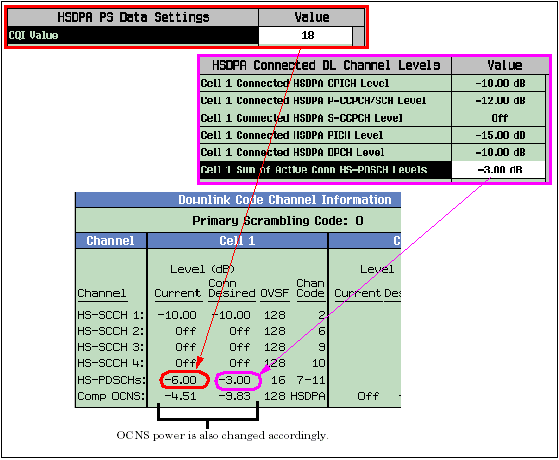
CQI Valuecan be set between 5 and 30. The following table, MAC-hs and IP Bit Rates (kbps) versus CQI Value and UE Category , summarizes the MAC-hs and IP bit rates achieved for eachCQI Value, based on UE category.The MAC-hs bit rate is determined by multiplying the MAC-hs block size by the number of MAC-hs blocks transmitted per second. If inter-TTI interval * number of HARQ processes < 6, the number of MAC-hs blocks transmitted in 12 ms is equal to the number of HARQ processes, and the following formula applies:
MAC-hs bit rate = (MAC-hs block size in bits)*(number of HARQ processes)/12 ms
The maximum theoretical IP bit rate is determined by multiplying the number of IP bits delivered in each MAC-hs block by the number of MAC-hs blocks transmitted per second. If inter-TTI interval * number of HARQ processes < 6, then the following formula applies:
IP bit rate = FLOOR[((MAC-hs block size in bits) - (21 MAC-hs header bits))/(MAC-d PDU Size)]*(MAC-d PDU Size - 16 header bits)*(number of HARQ processes)/12 ms
Note that although the bit rates are equal between categories 1/2, 3/4, and 5/6, due to the larger IR buffer size of categories 2, 4 and 6, in a network these categories may realize higher actual data rates.
MAC-hs and IP Bit Rates (kbps) versus CQI Value and UE Category 1, 2 3, 4 5, 6 7, 8 9, 13, 17 (64QAM/MIMO not configured) 10, 14, 18 (64QAM/MIMO not configured) 11 12 13, 17 (64QAM configured) 14, 18 (64QAM configured) CQI Value MAC-hs (kbps) IP (kbps) MAC-hs (kbps) IP (kbps) MAC-hs (kbps) IP (kbps) MAC-hs (kbps) IP (kbps)
MAC-d
PDU Size = 336 bitsIP (kbps)
MAC-d
PDU Size = 656 bitsMAC-hs (kbps) IP (kbps)
MAC-d
PDU Size = 336 bitsIP (kbps)
MAC-d
PDU Size = 656 bitsMAC-hs (kbps) IP (kbps)
MAC-d
PDU Size = 336 bitsIP (kbps)
MAC-d
PDU Size = 656 bitsMAC-hs (kbps) IP (kbps) MAC-hs (kbps) IP (kbps) MAC-hs (kbps) IP (kbps)
MAC-d
PDU Size = 336 bitsIP (kbps)
MAC-d
PDU Size = 656 bitsMAC-hs (kbps) IP (kbps)
MAC-d
PDU Size = 336 bitsIP (kbps)
MAC-d
PDU Size = 656 bits5 63 53 94 80 189 160 189 160 N/A 189 160 N/A 189 160 N/A 94 80 189 160 188 160 N/A 188 160 N/A 6 77 53 115 80 231 160 231 160 N/A 231 160 N/A 231 160 N/A 115 80 231 160 232 160 N/A 232 160 N/A 7 108 53 163 80 325 160 325 160 N/A 325 160 N/A 325 160 N/A 163 80 325 160 324 160 N/A 324 160 N/A 8 132 107 198 160 396 320 396 320 320 396 320 320 396 320 320 198 160 396 320 396 320 320 396 320 320 9 155 107 233 160 466 320 466 320 320 466 320 320 466 320 320 233 160 466 320 464 320 320 464 320 320 10 210 160 316 240 631 480 631 480 320 631 480 320 631 480 320 316 240 631 480 632 480 320 632 480 320 11 247 213 371 320 742 640 742 640 640 742 640 640 742 640 640 371 320 742 640 744 640 640 744 640 640 12 290 267 436 400 871 800 871 800 640 871 800 640 871 800 640 436 400 871 800 872 800 640 872 800 640 13 380 320 570 480 1140 960 1140 960 960 1140 960 960 1140 960 960 570 480 1140 960 1144 960 960 1144 960 960 14 431 373 646 560 1292 1120 1292 1120 960 1292 1120 960 1292 1120 960 646 560 1292 1120 1296 1120 960 1296 1120 960 15 553 480 830 720 1660 1440 1660 1440 1600 1660 1440 1600 1660 1440 1600 830 720 1660 1440 1664 1440 1600 1664 1440 1600 16 594 533 891 800 1783 1600 1783 1600 1600 1783 1600 1783 1600 1600 830 * 720 * 1660 * 1440 * 1788 1600 1600 1788 1600 1600 17 698 640 1047 960 2095 1920 2095 1920 1920 2095 1920 1920 2095 1920 1920 830 * 720 * 1660 * 1440 * 2100 1920 1920 2100 1920 1920 18 777 693 1166 1040 2332 2080 2332 2080 2240 2332 2080 2240 2332 2080 2240 830 * 720 * 1660 * 1440 * 2336 2080 2240 2336 2080 2240 19 881 800 1322 1200 2644 2400 2644 2400 2560 2644 2400 2560 2644 2400 2560 830 * 720 * 1660 * 1440 * 2648 2400 2560 2648 2400 2560 20 981 907 1472 1360 2944 2720 2944 2720 2560 2944 2720 2560 2944 2720 2560 830 * 720 * 1660 * 1440 * 2948 2720 2560 2948 2720 2560 21 1092 1013 1639 1520 3277 3040 3277 3040 2880 3277 3040 2880 3277 3040 2880 830 * 720 * 1660 * 1440 * 3284 3040 2880 3284 3040 2880 22 1195 1120 1792 1680 3584 3360 3584 3360 3200 3584 3360 3200 3584 3360 3200 830 * 720 * 1660 * 1440 * 3592 3360 3200 3592 3360 3200 23 1195 * 1120 * 1792 * 1680 * 3584 * 3360 * 4860 4480 4480 4860 4480 4480 4860 4480 4480 830 * 720 * 1660 * 1440 * 4868 4480 4480 4868 4480 4480 24 1195 * 1120 * 1792 * 1680 * 3584 * 3360 * 5709 5280 5440 5709 5280 5440 5709 5280 5440 830 * 720 * 1660 * 1440 * 5716 5280 5440 5716 5280 5440 25 1195 * 1120 * 1792 * 1680 * 3584 * 3360 * 7206 6720 6720 7206 6720 6720 7206 6720 6720 830 * 720 * 1660 * 1440 * 7212 6720 6720 7212 6720 6720 26 1195 * 1120 * 1792 * 1680 * 3584 * 3360 * 7206 * 6720 * 6720 * 8160 8320 8619 8160 8320 830 * 720 * 1660 * 1440 * 7888 7360 7680 7888 7360 7680 27 1195 * 1120 * 1792 * 1680 * 3584 * 3360 * 7206 * 6720 * 6720 * 8619* 8160* 8320* 10877 10240 10560 830 * 720 * 1660 * 1440 * 10884 10240 10560 10884 10240 10560 28 1195 * 1120 * 1792 * 1680 * 3584 * 3360 * 7206 * 6720 * 6720 * 8619* 8160* 8320* 11685 11040 11200 830 * 720 * 1660 * 1440 * 13252 12480 12800 13252 12480 12800 29 1195 * 1120 * 1792 * 1680 * 3584 * 3360 * 7206 * 6720 * 6720 * 8619* 8160* 8320* 12111 11520 11520 830 * 720 * 1660 * 1440 * 16132 15200 15680 16132 15200 15680 30 1195 * 1120 * 1792 * 1680 * 3584 * 3360 * 7206 * 6720 * 6720 * 8619* 8160* 12779 12160 12160 830 * 720 * 1660 * 1440 * 16132* 15200* 15680* 19288 18240 18560 * denotes that a "Reference power adjustment" is specified by the CQI Value(in other words, although the bit rate is the same as the bit rate for the precedingCQI Value, the power in the HS-PDSCHs is reduced).Bold font denotes 16QAM modulation. Emphasis font denotes 64QAM modulation. GPIB command: CALL:HSDPa:SERVice:PSData:CQI[:VALue]
-
CQI Valuefor MIMOThis parameter specifies the CQI value used to configure the HSDPA channel when
Current MIMO Configuration StateisActive, PS Data HS-DSCH Configuration Type is set toCQI Value,and PS Data HS-DSCH MAC Entityis set toMAC_ehs.GPIB command: CALL:HSDPa:SERVice:PSData:MIMO:CQI:VALue
-
PS Data Primary Precoding WeightThis parameter specifies the primary precoding weight when MIMO is configured in the PS Data call. This seeting applies when
PS Data HSDPA MIMO StateisOn, PS Data HS-DSCH Configuration Type is set toCQI ValueorUser Defined,and PS Data HS-DSCH MAC Entityis set toMAC_ehs.GPIB command: CALL:HSDPa:SERVice:PSData:MIMO:PPWeight[:STATic]
-
PS Data User Def Number of Transport
			 Blocks
This parameter specifies the number of DL transport blocks when PS Data HS-DSCH Configuration Type is set to
User Defined,PS Data HS-DSCH MAC Entityis set toMAC_ehs, andPS Data HSDPA MIMO StateisOn, .GPIB command: CALL:HSDPa:SERVice:PSData:UDEFined:MIMO:TBLock:COUNt
-
PS Data User Defined Active HS-PDSCHsSets the number of HS-PDSCHs transmitted by the test set. This setting affects the transport block size (see PS Data User Def Transport Block Size Index ). You can change this setting while on a connection.
The number of HS-PDSCHs specified by this setting, when added to the PS Data First HS-PDSCH Channel Code cannot exceed 15 (otherwise the HS-PDSCHs would collide with the downlink OCNS channels).
This parameter is only applicable when the PS Data HS-DSCH Configuration Type is set to
User Defined.GPIB command: CALL:HSDPa:SERVice:PSData:UDEFined:HSPDschannel:COUNt [:DCH]
PS
			 Data User Defined Active HS-PDSCHs(FACH)
Sets the number of HS-PDSCHs transmitted by the test set. This setting affects the transport block size (see PS Data User Def Transport Block Size Index ) and Cell_FACH PS Data Modulation Type. You can change this setting while on a connection.
The number of HS-PDSCHs specified by this setting, when added to the PS Data First HS-PDSCH Channel Code cannot exceed 15 (otherwise the HS-PDSCHs would collide with the downlink OCNS channels).
This parameter is only applicable when the PS Data HS-DSCH Configuration Type is set to
User Defined.GPIB command: CALL:HSDPa:SERVice:PSData:UDEFined:HSPDschannel:COUNt:FACH
-
PS Data User Def Transport Block
			 Size Index
GPIB command: CALL:HSDPa:SERVice:PSData:UDEFined:TBSize:INDex[:DCH]
PS Data User Def Transport Block Size Index(FACH)This parameter specifies transport block size index. The setting is used along with CELL_FACH PS Data Number of Active HS-PDSCHs and CELL_FACH PS Data Modulation Type to determine the actual transport block size for HS-DSCH CELL_FACH operation.
GPIB command: CALL:HSDPa:SERVice:PSData:UDEFined:TBSize:INDex:FACH
-
PS Data User Defined Modulation TypeGPIB command: CALL:HSDPa:SERVice:PSData:UDEFined:MODulation[:TYPE][:DCH]
PS
			 Data User Defined Modulation Type (FACH)
This parameter specifies whether QPSK, 16QAM or 64QAM modulation is used on the currently active HS-PDSCH channels. The setting is used along with CELL_FACH PS Data Number of Active HS-PDSCHs and CELL_FACH PS Data Transport Block Size Index to determine the actual transport block size for HS-DSCH CELL_FACH operation.
GPIB command: CALL:HSDPa:SERVice:PSData:UDEFined:MODulation[:TYPE]:FACH
-
PS Data User Def Secondary TB Size
			 Index
This parameter specifies the secondary transport block size index for MIMO when PS Data HS-DSCH Configuration Type is set to
User Defined,PS Data HS-DSCH MAC Entityis set toMAC_ehs, andPS Data HSDPA MIMO StateisOn.GPIB command: CALL:HSDPa:SERVice:PSData:UDEFined:STBSize:INDex
-
PS Data User Def Secondary TB Modulation
			 Type
This parameter specifies the modulation type of the secondary transport block and determines the actual secondary transport block size. The setting applies when PS Data HS-DSCH Configuration Type is set to
User Defined,PS Data HS-DSCH MAC Entityis set toMAC_ehs, andPS Data HSDPA MIMO StateisOn, .GPIB command: CALL:HSDPa:SERVice:PSData:UDEFined:STBLock:MODulation[:TYPE]
-
PS Data HS-DSCH 64QAM Configured
			 State
GPIB command: CALL:HSDPa:SERVice:PSData:QAM64:STATe[:DCH]
PS Data HS-DSCH 64QAM Configured State(FACH)GPIB command: CALL:HSDPa:SERVice:PSData:QAM64:STATe:FACH
-
PS Data HS-DSCH TB Size TableGPIB command: CALL:HSDPa:SERVice:PSData:MACEHS:HSDSchannel:TBSTable:ALIGnment
-
PS Data User Def Transport Block
			 Size Index
Sets k i (transport block size index) as described in 3GPP TS 25.321 s9.2.3. You can change this setting while on a connection.
You cannot directly set the HS-DSCH (MAC-hs) transport block size. Rather, you must set the PS Data User Defined Active HS-PDSCHs , PS Data User Defined Modulation Type , and
 PS Data User Def
			 Transport Block Size Index
. The test set then calculates the HS-DSCH transport block size from these three settings. You can query the transport block size using the CALL:STATus:HSDSchannel:TBSize? command.3GPP TS 25.321 Annex A provides a mapping of the index k t to HS-DSCH transport block size. 25.321 s9.2.3.1 specifies that k t = k i + k 0,i . 25.321 Table 9.2.3.1 provides values for k 0,i for different modulation types and number of active HS-PDSCHs. Thus, the HS-DSCH transport block size can be directly determined from the modulation type, number of active HS-PDSCHs, and transport block size index. For example, for a modulation type of 16QAM and 5 HS-PDSCHs, k 0,i = 131. Choosing a value of k i = 48 results in a value of 179 for k t , which is an HS-DSCH transport block size of 7298 bits.
Note, if you set
 PS Data User Def Transport
			 Block Size Index
to a value that results in a transport block size that exceeds the maximum value for the Current UE HS-DSCH Category (see 3GPP TS 25.306 Table 5.1a), the test set will post a warning, but will still transmit using the requested block size. Transmitting too large of a block to the UE will likely result in undesirable behavior (the UE may stop its HS-DSCH reception altogether, and you may need to end and re-establish the connection with a smaller block size).Note, the test set ensures that the transport block size index does not cause the MAC-hs to become too small to carry a single MAC-d PDU (configured using the PS Data HS-DSCH MAC-d PDU Size parameter). Therefore, if a change is made to this parameter that results in too small of MAC-hs block size it will be rejected by the test set.
GPIB command: CALL:HSDPa:SERVice:RBTest:UDEFined:TBSize:INDex
This parameter is only applicable when the PS Data HS-DSCH Configuration Type is set to
User Defined.GPIB command: CALL:HSDPa:SERVice:PSData:UDEFined:TBSize:INDex
-
PS Data User Defined Modulation TypeSets the modulation type used on the HS-PDSCHs. This setting affects the transport block size (see PS Data User Def Transport Block Size Index ). You can change this setting while on a connection.
Note, not all UE categories support 16QAM. If you set
PS Data User Defined Modulation Typeto16QAMwhen Current UE HS-DSCH Category is reporting a category that does not support 16QAM (see 3GPP TS 25.306 Table 5.1a), the test set will post a warning, but will still transmit using 16QAM modulation.Note, if you set
PS Data User Defined Modulation Typeto a value that results in a transport block size that exceeds the maximum value for the Current UE HS-DSCH Category (see 3GPP TS 25.306 Table 5.1a), the test set will post a warning, but will still transmit using the requested block size. See PS Data User Def Transport Block Size Index for more details.This parameter is only applicable when the PS Data HS-DSCH Configuration Type is set to
User Defined.GPIB command: CALL:HSDPa:SERVice:PSData:UDEFined:MODulation[:TYPE]
-
PS Data Minimum Inter-TTI IntervalThis parameter sets the control state and value of the of the minimum inter-TTI interval used on the downlink.
The control state can be set to Auto or Manual mode. When in Auto mode, the minimum inter-TTI used on an HSDPA or HSPA PS data call is the minimum inter-TTI supported by the Current UE HS-DSCH Category. When in set to a value (manual mode), this parameter controls the absolute inter-TTI interval.
Note, not all UE categories support an inter-TTI interval of less than 3 (see 3GPP TS 25.306 Table 5.1a). If you set
PS Data Minimum Inter-TTI Intervalto a value that is not supported by the Current UE HS-DSCH Category , the test set will post a warning, but will still transmit using the specified inter-TTI interval.You can change this setting while on a connection.
GPIB commands:
Control State: CALL:HSDPa:SERVice:PSData:ITTI[:INTerval]:MINimum:CONTrol:AUTO
Manual Setting: CALL:HSDPa:SERVice:PSData:ITTI[:INTerval]:MINimum:MANual -
PS Data HS-DSCH 64QAM Configured StateGPIB command: CALL:HSDPa:SERVice:PSData:QAM64:STATe
-
PS Data HS-DSCH TB Size TableGPIB command: CALL:HSDPa:SERVice:PSData:MACEHS:HSDSchannel:TBSTable:ALIGnment
Secondary Serving Cell Parameters
Secondary
			 Serving Cell HS-DSCH Configuration Type
GPIB command: CALL:HSDPa:SSCell:PSData:HSDschannel:CONFig[:TYPE]
-
Secondary Serving Cell CQI ValueGPIB command: CALL:HSDPa:SSCell:PSData:CQI[:VALue]
-
PS Data User Defined Secondary Cell
			 Active HS-PDSCHs
GPIB command: CALL:HSDPa:SSCell:PSData:UDEFined:HSPDschannel:COUNt
-
PS Data User Def Secondary Cell TB
			 Size Index
GPIB command: CALL:HSDPa:SSCell:PSData:UDEFined:TBSize:INDex
-
PS Data User Defined Secondary Cell
			 Modulation Type
GPIB command: CALL:HSDPa:SSCell:PSData:UDEFined:MODulation[:TYPE]
-
PSD Secondary Cell Minimum Inter-TTI
			 Interval
GPIB commands:
Control State: CALL:HSDPa:SSCell:PSData:ITTI[:INTerval]:MINimum:CONTrol:AUTO
Manual Setting: CALL:HSDPa:SSCell:PSData:ITTI[:INTerval]:MINimum:MANual -
PSD Secondary Cell HS-DSCH 64QAM
			 Configured State
GPIB command: CALL:HSDPa:SSCell:PSData:UDEFined:QAM64:STATe
-
PSD Secondary Cell HS-DSCH TB Size
			 Table
GPIB command: CALL:HSDPa:SSCell:PSData:MACEHS:HSDSchannel:TBSTable:ALIGnment