Power versus Time Measurement Description
Last updated: November 25, 2010
The Power versus Time Measurement is applicable to GSM/GPRS/EGPRS lab application and a test application with the required license.
- How is a Power versus Time (PvT) measurement made?
- Power vs. Time Parameters
- Power versus Time Measurement Results
- Power vs. Time Input Signal Requirements
How is a Power versus Time (PvT) measurement made?
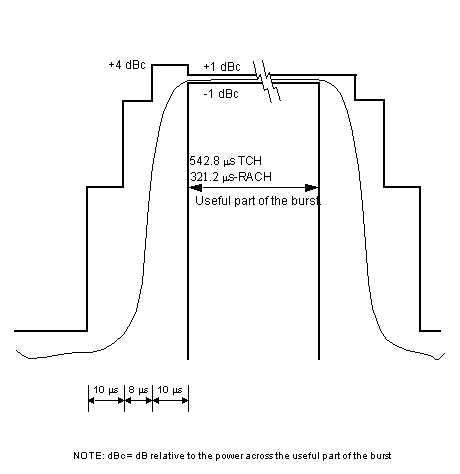
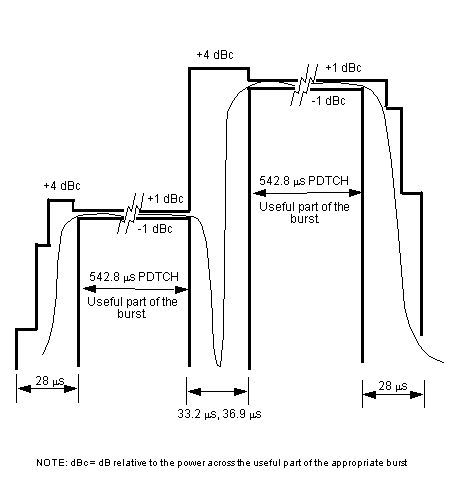
PvT measurements determine if the mobile station's transmitter power stays within specified power and timing ranges. Refer to the Typical GSM PvT Measurement and Typical PvT Mask for a Two Burst Multislot Configuration .
During a PvT measurement, the test set makes a narrowband point-by-point measurement of the instantaneous power received during the signal burst as it varies across a single burst or up to six adjacent modulated TDMA bursts. The
Burst Capture Range
parameter determines the maximum number of TDMA bursts that the PvT measurement can measure. When the
Burst Capture Range
is set to
Single
, the PvT measurement can measure up to 2 adjacent modulated TDMA bursts. When the
Burst Capture Range
is set to
All
, the PvT measurement can measure up to 6 adjacent modulated TDMA bursts. A single pass or fail result is returned for the entire multislot configuration. This means that if any part of the multislot configuration fails the multislot mask, the result is a Fail. Additional information is provided to indicate which segments of the multislot configuration have failed.
Included with the narrowband measurement are broad-band carrier power measurements, labeled as Transmit Power on the
Burst Numeric Results
screen. The PvT Transmit Power measurement is synchronized to the burst midamble as recommended in 3GPP 51.010 (formerly ETSI GSM 11.10). (The test set also provides a faster transmit power measurement that is synchronized to the burst's amplitude. See
Transmit Power Measurement Description
).
You can also control the modulation and coding scheme (either GMSK, 8PSK or 16QAM modulation) used by the data connection to be measured using CALL:(PDTCH|PDTChannel):MCSCheme . Additionally, you can manually control what modulation should be expected for individual bursts using CALL:MODulation[:FORMat]:CONTrol:AUTO . See Modulation Format Control (EGPRS only) for more information.
This measurement conforms to ETSI GSM 05.05 (Ver 8.2.0, 7.2.0, 6.6.0), section 4.5 and Annex B. It will also conform with 3GPP 51.010 (formerly ETSI GSM 11.10) if used as part of a type approval system.
Types of Signals Power vs. Time Can Measure
The following list summarizes the input signal attributes for making PvT measurements.
- A Single normal burst, or up to 2 normal bursts when Burst Capture Range is set to Single.
-
A Single normal burst, or up to 6 normal bursts when Burst Capture Range is set to All.
-
GSM RACH burst when Burst Capture Range is set to Single.
-
CW signals.
For details on the multislot configurations which the test set supports, see CALL:(PDTCH|PDTChannel):MSLot:CONFig .
Operating Consideration
You can perform the PvT measurement in all operating modes except
Cell Off
and
Fast Device Tune
. However, you must set the modulation format and the expected power correctly in order to get the accurate power result of the measured bursts. See
"Expected Power Control" on page 6
and
"Modulation Format Control (EGPRS only)" on page 10
to find how to set the modulation format and the expected power.
In the Active Cell mode, the test set automatically passes the Training Sequence Code (TSC) to the measurement with no action required by you. However, you must specify the TSC manually in the test mode.
The dynamic range of the PvT measurement is approximately 70 dB.
Power vs. Time Parameters
-
Burst Capture Range
This parameter determines whether the uplink burst are captured individually or simultaneously during the PvT measurement. The default value for this parameter is
Single. When Burst Capture Range is set toSingle, the PvT measurement can measure up to two bursts, which are captured in two TDMA frames. When Burst Capture Range is set toALL, the PvT measurement can measure up to six bursts, which are captured in one TDMA frame.The GPIB command to set this parameter is SETup:PVTime:BURSt:CAPTure .
-
Burst Synchronization
The PvT measurement provides you with a choice for the time reference setting (burst synchronization) for a single uplink burst. In the case of measuring multiple uplink bursts the burst synchronization is fixed to Midamble. If a valid midamble cannot be found, the measurement will complete on a best effort basis using RF Amplitude synchronization. See Burst Synchronization of Measurements .
Description References measurement timing to the midamble transmitted within a timeslot. The amplitude rise and fall of a transmitted burst determines the measurement time reference. No edge of the burst will be detected, the measurement will be made using the first 87 or 147 bits of data found centered around the middle of the expected burst position. None may be used when measuring non-bursted (CW) signals. Note, the Burst Synchronization is set to Midamble and can not be changed in the following scenarios:
- When measuring multi-bursts.
- The Burst Capture Range is set to All.
- The operating mode is Active cell (EGPRS), EGPRS BCH, EGPRS BCH+TCH, or EGPRS BCH+PDTCH+TCH.
The GPIB command to set this parameter is SETup:PVTime:BSYNc or SETup:PVTime:SYNC .
-
Graph Power Reference
This parameter determines which burst's Transmit Power is used as the reference value for the PvT graph. This value will effect the results from the FETCh:PVTime:SECTion and FETCh:PVTime:TRACe commands.
Note, when Burst Capture Range is set to
SINGle, setting Power Reference to Burst 3 to 6 will cause "Illegal parameter value" error.The GPIB command to set this parameter is: SETup:PVTime:GRAPh:POWer:REFerence
-
Graph State
This command is used to turn on or off the PvT Measurement graphics state. Setting the Graph State to ON does not automatically force the graphical view to be displayed. You should manually change the view to Graph. Noted that turning the graph state to ON will slow the measurement.
The GPIB command to set this parameter is: SETup:PVTime:GRAPh:STATe
-
Graph Time Reference
This command is used to determine which burst is used as the time reference for the graph.
Note, when Burst Capture Range is set to
SINGle, setting Power Reference to Burst 3 to 6 will cause "Illegal parameter value" error.The GPIB command to set this parameter is: SETup:PVTime:GRAPh:TIME:REFerence
-
Log Detector Video Filter
This parameter allows you to choose a filter to apply to the log-detector (LD) trace output. You can select a 1MHz Video Bandwidth Filter or a 300kHz filter. The default setting is 1MHz Video Bandwidth Filter. 300KHz Filter can helps you to filter out more noise. However the 300KHz filter is only applicable to GMSK modulated signals.
This parameter can only be set via GPIB command.
The GPIB command to set this parameter is: SETup:PVTime:VIDeo:FILTer:BWIDth
-
Mask Type
This parameter allows you to select the type of mask to be used for a specified burst.
There will be four independent mask definitions available:
- One fixed GMSK Mask according to ETSI GSM 05.05 v8
- One fixed 8-PSK Mask according to ETSI GSM 05.05 v8
- Two custom Masks configurable by the user
The first two masks are configured according the ETSI GSM 05.05 v8. These two fixed masks are selectable through the Mask Type ETSI, have a fixed length and can not be modified by the user. The two custom masks are of variable size and user settable, you can specify up to a maximum of 32 upper points and 32 lower points to define a custom mask.
The GPIB command to set the Mask type is: SETup:PVTime[:BURSt[1]]:MASK[:SELected] or SETup:PVTime:BURSt2|3|4|5|6:MASK[:SELected] .
The GPIB commands to set the lower limits for the specified custom mask are SETup:PVTime:CUSTom1:MASK:LOWer? and SETup:PVTime:CUSTom2:MASK:LOWer? . Use SETup:PVTime:CUSTom1:MASK:LOWer:POINts? and SETup:PVTime:CUSTom2:MASK:LOWer:POINts? to query the number of reference points for the specified user settable lower mask.
The GPIB commands to set the upper limits for the specified custom mask are SETup:PVTime:CUSTom1:MASK:UPPer? and SETup:PVTime:CUSTom2:MASK:UPPer? . Use SETup:PVTime:CUSTom1:MASK:UPPer:POINts? and SETup:PVTime:CUSTom2:MASK:UPPer:POINts? to query the number of reference points for the specified user settable upper mask.
-
Measurement Offsets
The PvT measurement has a fixed number of twelve offset settings for every active burst of the TDMA frame, up to 6 uplink time slots (only when capture mode is set to
ALL). Each burst's offset times are referenced to the centre of symbol 0 for that burst (the start of the useful part of the burst). A single reference point for a multislot configuration is not used because the measurement may be made in two separate passes and the guard period between bursts can vary in length.The GPIB command to set this parameter is: SETup:PVTime[:BURSt[1]]:TIME[:OFFSet][:SELected] or SETup:PVTime:BURSt2|3|4|5|6:TIME[:OFFSet][:SELected]
-
Measurement Timeout
You can set the timeout state and time for this measurement. To set them separately, use SETup:PVTime:TIMeout:STATe to set the timeout state, SETup:PVTime:TIMeout:TIME to set the timeout time; use SETup:PVTime:TIMeout[:STIMe] to set the state and time simultaneously.
-
Multi Measurement
You can set Multi-Measurement state and count for the PvT measurement. If Multi-Measurement State is
On, Multi-Measurement Count determines how many measurements are to be performed for a measurement request. If Multi-Measurement State isOff, no Multi-Measurement are performed.The PvT measurement use the standard Multi-Measurement implementation. Each Multi-Measurement returns the average value, maximum value, minimum value and standard deviation for the number of counts selected. No intermediate results are returned during a Multi-Measurement.
Multi-Measurement count specifies how many loops are measured for a measurement request.
To set Multi-Measurement state and count separately, use SETup:PVTime:COUNt:STATe to set the Multi-Measurement state, SETup:PVTime:COUNt:NUMBer to set the Multi-Measurement count; use SETup:PVTime:COUNt[:SNUMber] to set the state and count simultaneously.
-
Ranging Mode
This parameter is only applicable when measuring two bursts and the Burst Capture Range is set to
Single.The Ranging Mode parameter helps you to strike a balance between dynamic range and Linearity. There are two Ranging Modes available:
-
High Linearity Mode (HLINear)
The High Linearity Mode ensures the accuracy of the PvT trace during the active part of the burst at the expense of some loss in dynamic range.
- High Dynamic Range Mode (HDynamic) The High Dynamic Range Mode gives you the full dynamic range but the power result slightly higher at the front and the end of the burst.
The GPIB command to set this parameter is SETup:PVTime:RANGing[:MODE]
-
High Linearity Mode (HLINear)
-
Trigger Arm
Trigger arm can be set to
SingleorContinuous, See Trigger Arm (Single or Continuous) Description for more information.The GPIB command to set this parameter is SETup:PVTime:CONTinuous[:SELected] .
-
Trigger Delay
This is the specified time between the trigger event and when the test set begins sampling data. See Trigger Delay Description for more information.
The GPIB command to set this parameter is SETup:PVTime:TRIGger:DELay .
-
Trigger Source
The triggering choices available for the PvT measurement are RF rise, protocol, immediate, and auto. In most cases, auto triggering provides the optimum measurement triggering condition for the PvT measurement.
When auto triggering is selected, the test set chooses a trigger source based on the optimum trigger source available. For example, PvT measurements are automatically triggered by a protocol trigger if a data connection is established or data connection processing events provide the protocol trigger source.
In situations where no protocol trigger is available, the test set chooses RF rise triggering for the PvT measurement. An example of this situation is when the test set is in one of the test mode operating modes.
Recommended Trigger Source Operating mode Active Cell Note: RF Rise should be selected when measuring bursted signal with no valid midamble.
CW signal For more information on measurement triggering, refer to Triggering of Measurements .
The GPIB command to set this parameter is SETup:PVTime:TRIGger:SOURce
-
TX Power Method
This parameter allows you to select the transmit power measurement method for an 8PSK or 16QAM modulated signal.
In EGPRS operating mode, there are two methods to determine the transmit power of an 8PSK or 16QAM modulated signal: Burst Power and Estimated Carrier Power.
-
Burst Power
This is the average power measured across a single timeslot. This value varies as a function of the modulating data.
-
Estimated Carrier Power
This is an estimate of the power of the unmodulated carrier. The Estimated Carrier Power is equivalent to the Long Term Average Power which is the primary definition of 8PSK or 16QAM modulated signal power in the ETSI standards. Long Term Average Power is the average power of many individual bursts when the individual bursts are modulated with PRBS data. The Estimated Carrier Power measurement uses knowledge of the modulating data to determine the carrier power from the power measurement.
The GPIB command to set this parameter is: SETup:PVTime:ETXPower[:METHod]
-
Burst Power
Power versus Time Measurement Results
The primary result of a PvT measurement is the pass/fail result. The pass/fail result that the test set returns indicates whether the entire multislot configuration falls within power and timing ranges determined by a point-by-point comparison of the power versus time measurement mask.
The PvT measurement examines the multislot configuration to determine the points which have failed the most, or the points which are closest to failing the upper and lower limits. These worst case points provide the upper and lower limit margin results. A negative value, along with the offset time, is returned for the result if the multislot configuration fails the mask. A positive value indicates the multislot configuration is within the mask. The command FETCh:PVTime[:BURSt[1]]:MASK:ALL? and FETCh:PVTime:BURSt2|3|4|5|6:MASK:ALL? are used to return these values for the burst you specify.
For statistical analysis, the test set allows you to set up to 12 time markers per burst. These markers do not define the mask, but are merely used to get results from specified points on the mask. To set these markers you can use SETup:PVTime[:BURSt[1]]:TIME[:OFFSet][:SELected] and SETup:PVTime:BURSt2|3|4|5|6:TIME[:OFFSet][:SELected] . Note that these points are a subset of those used in the point-by-point comparison which determines the pass/fail result.
The Power versus Time measurement allows you to use the ETSI mask specification or define up to two custom masks of your own. For more information refer to Mask Type .
The following lists show the results available for single measurements, multi-measurements and statistical measurements:
-
Results for a single PvT measurement are listed below. Results 1 through 6 can be obtained using the query FETCh:PVTime[:BURSt[1]][:ALL]? and FETCh:PVTime:BURSt2|3|4|5|6[:ALL]? . Results 6 through 9 can be obtained using the query FETCh:PVTime[:BURSt[1]]:MASK:ALL? and FETCh:PVTime:BURSt2|3|4|5|6:MASK:ALL? .
-
PvT measurement integrity indicator for each burst in the multislot configuration
-
PvT multislot mask pass/fail result (0 = Pass, 1 & NaN = Fail)
-
Transmit power with midamble synchronization (average power during the burst) for each burst in the multislot configuration
-
PvT maximum power at up to 12 time offsets
- PvT mask error code (this indicates which parts of the multislot configuration are causing failure). For more details on the mask error code result see FETCh:PVTime:MASK[:FAIL]:SEGment? .
-
Upper limit power margin worst case for each burst in the multislot configuration (how close to or where the signal exceeded upper power limit)
-
Upper limit timing margin worst case for each burst in the multislot configuration (the time offset where the signal came close to or exceeded upper timing limit)
-
Lower limit power margin worst case for each burst in the multislot configuration (how close or where the signal exceeded lower power limit)
-
Lower limit timing margin worst case for each burst in the multislot configuration (the time offset where the signal came close to or exceeded lower timing limit)
-
-
In addition to the results you can obtain for a single measurement the following results are also available for
multi-measurements
. These results can be obtained using the query
FETCh:PVTime[:BURSt[1]]:TXPower[:CARRier]:ALL?
and
FETCh:PVTime:BURSt2|3|4|5|6:TXPower[:CARRier]:ALL?
.
-
Minimum transmit carrier power measured across each burst
-
Maximum transmit carrier power measured across each burst
-
Average of transmit carrier power measurements (average of averages) for each burst in the multislot configuration
-
Standard deviation of transmit carrier power measured across each burst
-
-
Statistical PvT measurement results, calculated from measurements taken at each of the active time offset markers or across a subset of the markers and available only through programming commands are listed below. These results can be obtained using the
FETCH:PVTime[:BURSt[1]]|BURSt2|BURSt3|BURSt4|BURSt5|BURSt6:POWerqueries.-
Average Power (in dBc) measured at the marker(s) relative to transmit power (carrier power)
-
Maximum power (in dBc) measured at the marker(s) relative to transmit power (carrier power)
-
Minimum power (in dBc) measured at the marker(s) relative to transmit power (carrier power)
-
Standard deviation of power (in dBc) measured at the marker(s) relative to transmit power (carrier power)
-
-
The measurement integrity indicator is another result available for any completed PvT measurement. This result provides information about error conditions which occurred and may have affected the accuracy of the most recently completed measurement. For more information about measurement integrity, refer to Integrity Indicator .
-
The measurement progress report is a feature that allows you to periodically see how far a multi-measurement cycle has progressed. When the multi-measurement count is greater than 1, the progress report indicates the number of individual sub-measurements that have been completed, n , out of the total number to be completed, m . "n" is referred to as ICOunt remotely. "m," the total number of measurements to be made, is based on the PvT settings you make and the input signal attributes.
The progress report is displayed on the test set's screen in an "n of m" format. The number of measurements completed, n , increases from zero to the total number of measurements which need to be made, m .
Power vs. Time Input Signal Requirements
The PvT measurement will complete and meet the PvT measurement accuracy specifications when the signal meets the following input signal conditions.
Related Topics
How Do I Make a Power Versus Time Measurement?
Programming a Power versus Time Measurement